

Observations
Autumn passage in full flow
A summary of the birds of September – October 2025
Autumn goose numbers were below par in September, with a maximum of 90 Canada Geese, 16 Greylags and 10 Egyptian Geese. The latter two disappeared entirely in October and Canada Geese were only up to 40 in number. A big arrival of Shovelers saw their numbers grow to 112, with four Wigeon, up to 89 Teal, and a female Pintail, whilst autumn Gadwall peaked at 371.
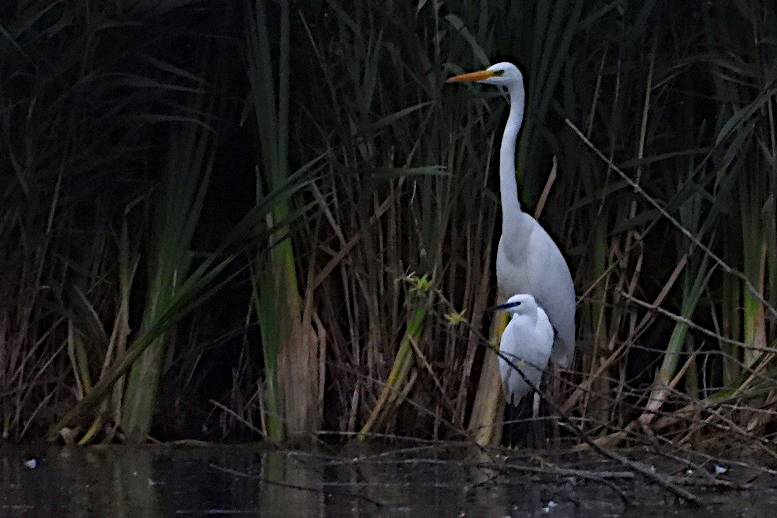
Water levels on No. 1 lagoon were dropped from mid September and the following days saw a big increase in fish eaters, with up to 64 Cormorants (including a Dutch-ringed bird), 14 Grey Herons and 14 Little Egrets. A Bittern was at the sushi party on two days, with three lumbering Great White Egrets for much of the period, including a colour-ringed bird, which proved to have been ringed in Lithuania! We know that Lithuanian Great White Egrets come to western Europe for the winter, but this is believed to be the first time one is recorded as reaching the UK.
Raptors included a kettle of 12 Red Kites one September day, the last few Hobbies, and a brief Marsh Harrier.
Wader highlight, from a limited list of candidates, was an adult male Ruff sauntering around the scrape and No. 1 lagoon. The Oystercatcher family lingered a while, and the first two Jack Snipe and up to eleven Snipe arrived. However the low water levels on No. 1 lagoon enabled a sudden mass arrival of Lapwings, eventually growing to a flock of 145. Finally the first two Curlews since October 2022 put in an appearance.
The southward roost movements of gulls yielded counts of 700 Black-headed, 115 Common, 75 Herring and 885 Lesser Black-backed Gulls, whilst a Yellow-legged Gull dropped in to bathe in No. 1 lagoon and an adult Kittiwake drifted over, our first ever autumn record. When terns were thought long gone, a migrating party of seven Common Terns dropped in for a short rest.
Kingfishers have made something of a comeback with up to four in September and three in October; a welcome revival in their appearances. 299 Woodpigeons went west; the usual question as to how far they came or went always produces some debate – but no answers. They are the most destructive agricultural avian ‘pest’ in the UK but we really don’t know much about them. The Stock Dove roost count at the final tanks came in at 70.
An impressive diurnal Swallow passage saw 261 pass south along with 45 House Martins, two Swifts and a single Sand Martin. Wet and windy weather in mid September corralled some hirundines: 120 House Martins, 25 Sand Martins (the last) and 20 Swallows, and the first six Meadow Pipits of the autumn dropped into the meadows.
During light south-westerlies, a strong southerly passage of several species included up to 67 Meadow Pipits, one Yellow Wagtail twice, ten Siskins and three single Redpolls, and the year’s second Skylark followed by up to eight more. In that context one wonders whether the Mistle Thrush seen passing south-east had come far. A late Grasshopper Warbler was flushed in the meadow.
The site has been overrun with Chiffchaffs, 65 in the north alone, building to a whopping 100 across the site by the end of September. October saw 27 still present mid month, with continuous single figure counts to the month’s end. Willow Warblers continued to trickle through in ones and twos in September, including a beautiful ‘acredula type’ caught and ringed. The race acredula originates from northernmost Scandinavia eastward into Russia. But, before we get overexcited, pale non-yellow Willow Warblers can crop up in any population, hence the ‘type’ caveat.
Sedge Warblers remained in small numbers through September, and Reed Warblers were more abundant as usual with the last six at the end of the month. A single Lesser Whitethroat was the only September record, and the last two Common Whitethroats in early September were likewise a very poor showing. Blackcap numbers dwindled slowly through October. Goldcrests arrived through late September followed by a mini arrival of 19 in October.
Two Whinchats arrived in early September, while Stonechats came later, as is tradition, with up to three. Blackbirds and Song Thrushes remained very scarce (September/October max of five and two respectively) so a flock of 25 Fieldfare were a welcome sight – our first since January 2024, having been absent for the entire 2024-25 winter. Redwings arrived in smaller numbers with up to four.